What's New -Sept 2026
Posted Monday, August 31, 2026

Sales
-
Stay on Top of Unsigned E-Sign Packages
When a sales team prepares an eSign package from the Contract tab and the customer, co-buyer, or dealer representative has not yet eSigned, a new alert will appear after 4 hours:
“Sales E-Sign Package Unsigned (4+ Hours)”
The alert is triggered 4 hours after the eSign package is requested if it remains unsigned. You can customize which staff members receive these notifications and set the initial snooze time in the Alert Settings.
Once notified, each staff member can also snooze the alert for a longer period if needed.
This makes it easier for your team to follow up on outstanding eSign packages and keep contracts moving forward.
-
New California ZEV Sales Tax Exemption Feature
We’ve added a new feature to help dealers apply the California Zero-Emission Vehicle (ZEV) partial sales tax exemption when applicable.
When completing a sale, go to Line 2 – Sales Tax and look for the “CDTFA ZEV Exemption” checkbox. When the box is selected, the system will apply the applicable tax reduction.
Important: This exemption is not automatically applicable to every EV sale or every buyer. The dealer is responsible for confirming that the transaction and purchaser meet the applicable California requirements and for maintaining the proper supporting documentation. CDTFA specifically requires documentation to support exemption claims.
Please make sure the required documentation is completed and retained before applying the exemption.
- Washington Luxury Vehicle Tax – July 1, 2026 Update
ASN has been updated to reflect the Washington Luxury Motor Vehicle Tax changes effective July 1, 2026. The system now accommodates the updated $102,000 deduction threshold and the new exemptions, including qualifying RV sales, nonresident sales, and certain tribal-member sales.
-
New: Trade Exterior & Interior Color
In the Sales > Trade tab, we’ve added a new Field #18 for entering the exterior and interior colors of the trade-in vehicle.
This makes it easier to capture and keep this information with the trade details.
-
New: Customer Account Balance Alerts
When structuring a new deal and adding a buyer, a new prompt will display the customer’s other account balances, giving your team visibility into any existing balances before completing the deal.
Once the deal is saved, a red Disclosure line will appear below the Save button in the Sales tab. This will show any Past Due Balance associated with the customer.
This added visibility helps your team identify outstanding balances early and consider whether they may impact the ability to collect the balance before the customer purchases another vehicle.
Contracts
-
LAW®553-SC(5P) 8/26 and LAW®553-SC-ARB 8/26
-
New Spanish Purchase Order Format
A new Spanish version of Purchase Order Format 3 is now available for dealers who need to provide purchase orders in Spanish.
When applicable, simply select the Spanish language box to produce a Spanish version of Purchase Order Format 3 for your customers.
-
New: Oregon DMV/DOJ Disclosure Form
For Oregon dealers, we’ve added a new Disclosure Form (HB 3178) to help meet Oregon DMV/DOJ requirements.
The form is designed to be signed along with the RISC contracts. Dealers no longer need to manually write or type the required information. Instead, the system uses a condensed version of the official Oregon state form, making the process faster and easier.
-
Updated Washington State Seller’s & Buyer’s Certificates
Washington dealers now have access to newer versions of the required certificates for out-of-state delivery of motor vehicles.
The updated forms include:
- Seller’s Certificate for Out-of-State Delivery of Motor Vehicles
- Buyer’s Certificate for Out-of-State Delivery of Motor Vehicles
These updated certificates help Washington dealers use the most current documentation when processing qualifying out-of-state vehicle deliveries.
Be sure your dealership is using the newer versions of these forms going forward.
Reports
- New California Sales Tax Worksheet Updates
ASN has added two enhancements to the California Sales Tax Worksheet to help dealers simplify quarterly reporting and provide the detail requested by CDTFA.
-
Line 11 – Nontaxable Transactions: A new pop-up breaks down Line 9 amounts by category, including Warranty, Fees, Sublet, and other nontaxable transactions. This helps staff properly itemize transactions and may reduce questions or audit concerns from CDTFA.
-
Line 13b – ZEV Discounted Rate: A new Line 13b identifies the tax amount for new vehicles sold using the current ZEV discounted tax rate of 3.97375%, making these transactions easier to identify and report.
These updates provide your staff with more detailed information directly in the worksheet and help make quarterly sales tax reporting easier and more accurate.
-
New: Trade Mileage on Trade Status Report
The Trade Status Report now includes the trade-in mileage, giving your team an additional detail when reviewing and tracking trade vehicles using the report.
-
New: Control Labor Hours on RO Printouts
Want to keep labor hours off your RO printouts by default? We’ve added a new Labor Hours on Printout setting under Defaults > Shop Defaults (line 9).
Choose Show or Hide to control whether labor hours appear on RO printouts. When set to Hide, printouts will display the total price without labor hours.
Need to show labor hours for a specific RO? Simply right-click the RO and select Show Labor Hours from the RO Print menu to override the default setting.
-
New: Clearly Identify Declined Repairs
Declined parts and repairs on any RO will now be displayed in a separate Declined group, making it easier for the shop team to explain to customers what was performed versus what was declined.
For Retail Repair Orders, declined items will be shown as Recommended Repairs Declined by Customer.
For Wholesale ROs, the group will instead be labeled Deferred Items to better reflect the workflow.
-
New: More Flexibility When Creating Kits
We’ve made creating Kits even more flexible for service shops!
Previously, when setting up a Kit, you could choose between Hours or a Flat Price. With this update, you can now enter both Hours and a Total Price when creating a Kit.
Software Tip:
Make Sure Customers Use a Hand-Drawn eSignature
Reminder: To make sure your customers use an actual hand-drawn signature for eSign instead of a name-generated signature, go to Settings → Default. Find Line #59 – eSign and change the setting from Allow to Hand-Drawn Only.
This ensures that customers provide a signature that is physically drawn rather than generated from their typed name.
-
The Upcoming version is 7.0.19.39 —Our newest update is rolling out in phases. If you don’t see it yet, no action is needed; it will arrive automatically. Once updated, you’ll have access to the latest features and improvements to keep your system running at its best.
California CARS Act Takes Effect October 1, 2026: What Dealers Need to Know
Posted Monday, August 31, 2026
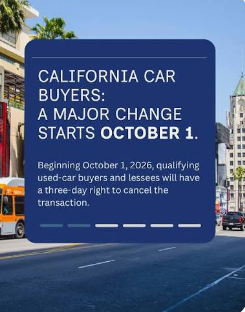
California dealers should be preparing now for significant changes coming October 1, 2026, when Senate Bill 766, commonly known as the California Combating Auto Retail Scams (CARS) Act, takes effect.
The new law introduces important requirements affecting the sale and lease of vehicles, including a new three-day cancellation right for qualifying used-vehicle transactions, new pricing and advertising requirements, additional rules concerning optional products, and increased recordkeeping responsibilities.
A New Three-Day Right to Cancel
One of the most significant changes is the new three-day right to cancel certain used-vehicle purchases and leases.
For qualifying used vehicles sold or leased for $50,000 or less, the customer will have a statutory right to cancel the transaction within the applicable three-day period. Unlike California's current optional cancellation program, the dealer cannot charge the customer for the right to cancel.
However, the law permits the dealer to charge a statutory restocking fee when the customer exercises the right to cancel.
The restocking fee is generally:
-
1.5% of the vehicle sale price
-
Minimum of $200
-
Maximum of $600
-
Plus, when applicable, $1 for each mile driven over 250 miles, up to an additional $150
The cancellation right also has a 400-mile limitation, making accurate mileage documentation at delivery and return particularly important.
Dealers Must Provide the Required Notice
The CARS Act requires dealers to provide customers with specific information concerning their cancellation rights. The purchase or lease agreement must also contain the required CARS Act notice.
Dealers should not think of this simply as adding another form to the deal jacket. The new requirements affect the overall transaction workflow, including sales, contracting, customer communications, F&I, and accounting.
Advertising and Pricing Requirements
The CARS Act establishes new requirements concerning the total price communicated to consumers.
Dealers should review how prices are presented across all channels, including:
A dealer's first written communication with a consumer concerning a specific vehicle can also trigger disclosure requirements. Dealers should therefore review their CRM templates and automated responses before October 1.
Optional Products and Add-Ons
The new law also places additional emphasis on optional products and add-ons.
Products should not be presented as required when they are optional, and dealers should take care to ensure that products being sold actually provide a benefit to the customer and are appropriate for the vehicle and transaction.
This means dealerships should review their F&I menus, product offerings and sales practices before the law becomes effective.
Cancellation Requires Good Recordkeeping
When a customer exercises the right to cancel, the dealer will need to document the transaction carefully.
Records may include:
-
Date and time the customer exercises the cancellation right
-
Vehicle mileage at delivery
-
Vehicle mileage at return
-
Condition of the returned vehicle
-
Restocking fee calculation
-
Refund calculation
-
Trade-in status
-
Proof of refund
-
Required cancellation documentation
The law also establishes record-retention requirements, making a complete electronic audit trail increasingly important.
What Does This Mean for ASN Dealers?
ASN Software is reviewing the CARS Act requirements and incorporating the necessary changes into the dealership workflow.
Our goal is to make compliance as straightforward as possible—not simply provide another form for dealers to remember.
For qualifying transactions, ASN can help dealers identify the applicable cancellation requirement, track the cancellation period and mileage, calculate the applicable restocking fee, produce required documentation, and maintain the transaction history.
ASN is also reviewing related areas including Inventory, CRM, Sales, F&I, Contracting, eSign and Accounting to help dealers manage the new requirements.
Dealers Should Prepare Now
Before October 1, dealers should:
1. Review their current cancellation procedures.
2. Review advertising and website pricing practices.
3. Review CRM email and text templates.
4. Review F&I products and optional add-ons.
5. Confirm that updated CARS Act forms and disclosures are available.
6. Train sales, F&I and accounting personnel.
7. Test their DMS workflow before October 1.
The CARS Act represents a meaningful change to California vehicle sales practices. Preparing early will give dealerships time to update procedures, train employees, and make sure their systems are ready.
ASN Software will continue monitoring the implementation of SB 766 and will provide additional information and system updates as the October 1, 2026 effective date approaches.
This article is intended as a general overview of the California CARS Act and is not legal advice. Dealers should consult their legal or compliance professionals regarding how the law applies to their specific transactions and business practices.
Used cars, new fraud
Posted Monday, August 31, 2026

Criminals don’t rely on fake pay stubs or forged signatures when they walk into your dealership anymore.
They’re using synthetic identities. They’re generating STIPS with AI. They’re recruiting straw buyers, creating fake employers, and stacking loans.
Modern-day fraudsters are sophisticated, organized, and harder to spot. The fraud you thought you knew is gone. So are more than 80,000 dealership vehicles every year.
I was talking with a close friend last week. We’ve both been in the car business for over 20 years. He owns a multi-rooftop group in California, and I run a software company in the auto industry.
His biggest concern isn’t inventory, fixed ops, or costs. He’s more worried about fraud right now, and he’s got company.
Experian says nearly nine in 10 dealerships consider fraud a significant concern.
Seven out of ten believe it’s getting worse.
Dealers report discovering an average of four fraudulent deals a year — many after the transaction has already been completed.
Nearly half lose $10,000 to $20,000 on a single deal.
Almost a third lose even more.
What’s worse is that 60% of auto lenders now mandate dealerships to buy back fraudulent loans, shifting the loss back to the retailer.
What are dealers up against?
Here are just a few of the tactics fraudsters are using now.
- “Synthetic identities,” which are completely fake borrowers with legitimate-looking credit histories.
- AI-generated documents — like bank statements and driver’s licenses — that are so convincing, they fool a well-trained eye.
- Straw buyers, or a person with legitimate credit financing vehicles for someone else who doesn’t qualify.
- Bust-out fraud, where criminals spend months building excellent credit, then finance multiple vehicles before fading into oblivion.
- Fake employers, where businesses are fabricated simply to verify employment when lenders call.
Once thieves take possession, they make cars disappear — or make money from them — ASAP. Some are exported overseas, others are title-washed or given new VINs, rented out, or sold for parts before lenders or law enforcement realize what happened.
The dealer immediately asks, “Who missed this?” And it’s a valid question. “Was it sales? F&I? The lender? Transport? Titling?”
It isn’t just a new car problem, because criminals aren’t after transportation. They’re after assets they can turn into fast cash, and used cars are often just as profitable, if not more.
And it isn’t just an F&I problem.
I believe it’s a process problem.
Your dealership might have a great CRM, credit platform, identity verification tool, or compliance solution. None of these, individually, are the problem. The problem is what happens between them.
Think about the average car deal today.
The customer’s information gets entered into one system, then re-entered into another. Supporting documents get uploaded here and downloaded there. The lender asks for more information. Someone else uploads those additional details somewhere else.
Each step seems innocent, but collectively, they create exposure. That’s because everyone is looking at one piece of the car sales transaction, but nobody is looking at the entire picture anymore. And that’s when patterns disappear.
Professional fraudsters don’t exploit your software systems. They exploit the gaps that exist between your systems. In other words, they don’t need your process to fail. They just need it to bend.
Here are three things you can do today to mitigate fraud.
- Verify identity before you verify anything else.
If you can’t confidently establish who’s standing in front of you — or sitting behind the screen — nothing else in the deal matters.
Everything downstream depends on getting this first step right.
- Close the gaps.
Every additional platform, login, transfer, upload, download, and re-enter creates another opportunity for something to be missed.
Your goal isn’t to find a single magical fraud solution. It’s about fixing the gaps in your process so fraud can’t hide.
- Make every deal follow the same process, every time.
Fraudsters love exceptions — like busy Saturdays, a customer everyone likes and “trusts,” a rushed delivery, or a deal ready to close (that everyone pushes through) because it’s 9:00pm and your store is ready to close, too.
The strongest and safest dealerships rely on one consistent process for every customer and every deal, every time.
Here’s how I see it.
The car deal tells a story.
Who is this customer? Where do they work? How do they earn a living? Does their income match their lifestyle? Does the documentation support the application?
Does their story make sense?
When that story gets scattered across seven or eight different systems, it’s much harder to notice when a chapter doesn’t fit.
Criminals have evolved and your process needs to evolve, too. The dealerships that win this battle aren’t the ones with the most software. They’re the ones with the strongest process.
Source: Autoremarkting
Used EV sales soar 10% in July amid greater supply & higher gas prices
Posted Monday, August 31, 2026

Used electric vehicle sales climbed more than 10% year-over-year in July and supply is becoming more plentiful, according to the EV Market Monitor Report released Monday by Cox Automotive.
There were 36,810 used EV sales last month, Cox said in the report, beating year-ago figures by 10.1% and surpassing June by 7.9%.
While Tesla continues to dominate the used EV market, brands like Ford (which had 18.9% month-over-month growth to lead all high-volume brands) as well as Chevrolet, Nissan and Cadillac continue to gain traction, Cox Automotive director of industry insights Stephanie Valdez Streaty said in the report.
Several high-volume models, including the Tesla Model 3, Tesla Model Y, Ford Mustang Mach-E, Hyundai IONIQ 5, Chevrolet Blazer, and Cadillac LYRIQ, helped drive July’s growth,” she said.
Dealers were able to get their hands on more used EVs last month, thanks in part to growing lease returns and trade-ins, Valdez Streaty said.
Used EV days’ supply, at 46 days, was up 13.6% from July 2025 and beat June numbers by 14.2%.
It was also the first month since February that days’ supply for used EVs was higher than that of used internal combustion engine vehicles.
Rivian showed the most growth, as days’ supply came in at 54 days, a 55% increase from June. Ford, which had days’ supply of 63, had the most inventory of used EVs, according to Cox.
Tesla had the lowest at 38.
“Despite the broader increase in inventory levels, the narrow three-day premium over ICE+ indicated used EV inventory remained broadly aligned with demand,” Valdez Streaty said, noting that Tesla and Rivian numbers only reflect the vehicles at traditional dealerships, not OEM-owned outlets.
Used EVs are also selling quickly, according to a separate report from Reynolds and Reynolds subsidiary AutoVision.
“As for what is selling quickly, some electric and hybrid vehicles are still moving swiftly, with less expensive internal combustion engine light vehicles filling in the gaps and dominating older model groups,” AutoVision said in its inaugural monthly report on the used-vehicle market.
Meanwhile, average listing prices on used EVs climbed 8.3% from July 2025 to come in at $37,832, which was 1.2% lower than June’s price, the Cox data shows.
Used EVs had a $2,967 premium over used ICE+ vehicles in July, compared to a $3,344 premium in June.
“Higher-priced brands such as Rivian and GMC continued to support the overall average, while high-volume brands including Tesla and Hyundai remained competitively priced,” Valdez Streaty said. “Despite the monthly decline, used EV prices remained well above year-ago levels, reflecting a growing share of newer-generation EVs entering the used market.”
That lift in used EV supply is one of the keys Valdez Streaty is watching in the months ahead.
She concludes the analysis noting that, “Inventory remains generally aligned with demand, while declining incentives, evolving pricing dynamics, and growing used EV availability will be key indicators of market performance in the months ahead.”
Used EV supply and prices is also something Cox Automotive is watching in the wholesale market.
According to the mid-month update of the Manheim Used Vehicle Value Index, wholesale prices on EVs are up 5% year-over-year, compared to a 1.4% decline for non-EVs.
“Gas prices remain a factor worth watching. The national average was $4.06 a gallon as of Aug. 17, up from roughly $3.14 a year ago. Used EVs are still benefiting from that increase, with values up 5% year over year even as the pace of gains has cooled,” Cox Automotive senior director Jonathan Gregory said in a separate analysis.
“That’s a normal glide path as off-lease EV supply, which we’ve been flagging all year, continues to build and gives buyers more choice.”
Source: AutoRemarketing
How dealers are revolutionizing auto remarketing with AI
Posted Monday, August 31, 2026

As artificial intelligence (AI) continues to evolve and gain traction in the automotive industry, it’s fundamentally changing the ways that dealers do business – and the auto remarketing sector is no exception. Todd Sanders, the Executive Director of Remarketing Services for Ally Financial, explains how AI can help dealers enhance inventory, improve pricing strategies, boost fraud-protection efforts and make condition inspections and reconditioning processes more efficient.
Q: How can AI-driven predictive analytics improve pricing and inventory-management strategies for auto dealers in the remarketing sector?
Todd Sanders: Used-car buyers have more information than ever at their disposal; by using more data-driven metrics on the wholesale values and predictive pricing, dealers can further refine their sourcing strategies. Rather than looking at stale comps or generic wholesale guidebook valuations, dealers can better predict valuations on what a specific vehicle will bring wholesale, in a specific condition and in a specific regional market. AI also can factor into inventory management by helping automotive dealers find and select vehicles that will sell faster within their markets and for higher grosses.
Q: What are the key benefits and challenges of implementing AI-powered tools for vehicle-condition assessments and reconditioning in auto remarketing?
Sanders: AI can help enhance the inspection process and inspection review by standardizing the inspection reports and process; enhancing accuracy with objective and consistent assessments that reduce some of the human error; and improving speed and efficiency by reducing the time and manpower needed to complete inspections.
On the flip side, the challenges for integrating AI into the vehicle-conditioning process include the need for significant amounts of comprehensive data to build those AI-enabled tools. Additionally, the variability of vehicles – from the types of vehicles to their age and condition – will also dramatically impact these data models. Moreover, the initial investments in these tools – including costs, time and training – are significant. In addition, they must be seamlessly integrating into current processes and procedures.
Automated condition reports benefit both buyers and sellers in a digital auction. Buyers receive more accurate and detailed inspection information, while sellers receive more detailed information about the condition of their inventory. One of the often-overlooked benefits of AI is enhanced transparency and trust. With more wholesale transactions moving to a digital space, accurate and detailed condition reports are the cornerstone of maintaining buyer trust because they leave less room for doubt or ambiguity. More trust fuels higher conversions, better customer retention and stronger relationships across the industry. Automated condition reports may lead to greater consistencies and help reduce potential arbitration disputes – both key metrics when gauging customer satisfaction.
"Automated condition reports benefit both buyers and sellers in a digital auction."
Q: In what ways can data analytics enhance customer targeting and personalization in the auto remarketing industry?
Sanders: In the “part-art, part-science” used-vehicle marketplace, AI can help remarketers provide vehicle listings to customers that fit well in their marketplace. Dealers always appreciate vehicles that sell quickly and at higher margins and remarketers can help those dealers turn a retail profit. To maximize customer value in the digital-auction space, matching the right vehicle with the right buyer is crucial to meeting customer expectations on every transaction. By using data, auctions can analyze buyer behaviors, user preferences and purchase histories to recommend vehicles based on past purchasing decisions. This maximizes opportunities to match the right buyers with the right vehicle for the buyer.
Similarly, AI can help determine vehicles that may not be the best fit for a particular market and then provide solutions to remarket that vehicle in a market that is a better fit. Auctions with a national reach and broad support in all markets are essential for dealers to optimize the remarketing process.
Q: How can AI and machine-learning algorithms help detect and prevent fraud in the auto-remarketing process?
Sanders: Fraud certainly has crept into all aspects of the remarketing process and the used-vehicle marketplace and AI is not a replacement for vigilance and attentiveness in preventing fraud. But AI can be used to augment existing efforts to prevent fraud and limit the potential for losses. For example, AI can:
- Support document-verification processes to help evaluate authenticity of images, paperwork and titles.
- Efficiently search and review multiple large datasets and cross-verify multiple datasets.
- Assist in near real-time monitoring of potential fraud indicators, which can help enable swift intervention and prevents losses.
Q: How can auto dealers leverage AI and data analytics to better understand and adapt to market trends and consumer behaviors in the used-car market?
Sanders: AI has entered most of our personal lives in some form or fashion. The used-car marketplace should be no different. As mentioned earlier, AI is not a replacement for processes or procedures. Instead, it should be used to augment and enhance those processes, keeping the human factor at the center of decision-making.
AI has the capability to process millions of variables simultaneously, from historical transaction data and individual VIN-level data to national and regional auction trends and overall macro-economic conditions – all of which can influence remarketing decisions for buyers and sellers. The ability to analyze large and diverse datasets enables dealers to obtain timely market analysis that helps them determine what is selling, what is not selling and where consumers are going.
Similarly, with that near real-time analysis, dealers can make determinations for future demand. In turn, that will drive future inventory planning, pricing-optimization strategies and cashflow needs for business growth that operates within risk boundaries. Of course, some market trends are unpredictable, such as COVID and the subsequent new-vehicle supply shock. As such, dealers must be ready to adapt to those unpredictable markets. But AI helps dealers operate within risk boundaries, become more agile and stay a step ahead of the market.
Source: AutoNews
What's New -Aug 2026
Posted Thursday, July 30, 2026

Sales
-
Feature: Prevent Finalizing Deals with Unpaid Down Payments
To ensure your accounting remains accurate and complete, we’ve added a new safeguard for finalizing deals. When enabled, the system will prevent a deal from being set to "FINAL" status if there is an outstanding balance on the received down payment.
- How to enable: Navigate to Settings > Defaults>Sales Defaults and set Line 13 – Reg DP Rcv's for Final to Yes.
Once enabled, the system will trigger a prompt if a user attempts to finalize a deal with an unpaid down payment balance, ensuring that all funds are collected before closing the deal. Deferred down payments are excluded from this rule. Deals can be finalized as long as there’s no balance on the cash down payment line.
- New Security Controls: Due Bill Management
We have added two new security items for the Sales/F&I Due Bills tab to give management better control over record updates:
- #951 - Edit Due Bill: Allows staff to add or remove items on an individual sale.
- #953 - Edit Due Bill Defaults: Controls access to the "Default Due Bill" lines.
This update allows you to grant your sales team the ability to manage due bills for specific deals without giving them permission to change or edit the foundational Default Due Bill information.
- Enhancement: Automated Commission Splits for Sales Teams
We’ve updated the Sales/Recap tab to streamline commission calculations for multi-person teams. If multiple team members share the same title, the system will now automatically apply commission splits based on the configuration in Defaults > Sales Defaults (Line 34 - Auto Split Commission). This update ensures consistent and accurate commission distribution across your sales and management teams.
Contracts
-
LAW®553-SC(5P) 8/26 and LAW®553-SC-ARB 8/26
Please note that a revision has been made to the LAW®553-SC(5P)8/24 contract as well as the
LAW®553-SC-ARB8/24. The new form numbers are LAW®553-SC(5P)8/26 and LAW®553-SC-ARB8/26.
Effective July 1st, 2026, the maximum allowable late charge amount has increased from $25.50 to $27.00, and the minimum late charge has increased from $10.20 to $10.80. We modified the Late Charge section to reflect the new amounts.
Inventory
-
Improved Inventory Detail View
We have enhanced the "Floored By" label (line 62) in the Inventory tab.
When hovering over this label, you will now see details for all associated floorings—even when multiple records exist. The tooltip now displays the following information for each flooring:
- Flooring company name
- Amount
- Date
- Current balance
Accounting
-
We are constantly working to improve your workflow in ASN Software. Based on your feedback, we added the ability to change the Bank Reconciliation date, giving you more control over your records.
What’s Changing?
You now have the flexibility to edit the date on your bank reconciliations!
If you need to adjust a reconciliation date, you can now do so as long as:
- The reconciliation is unlocked: You must have an unlocked status to make changes.
- The date is within range: You can update the date freely, provided it is not set to a future month and is not earlier than the date currently selected.
Why does this matter?
We know that accounting adjustments happen. This update allows you to correct dates on pending reconciliations without needing to delete and recreate them, saving you valuable time during your month-end process.
Reports
-
New Reporting Field: Track Lender Funding Speed
We’ve added the Funding_DaysUntilFunded field to our custom reporting tool. You can now create custom reports that calculate the average days to funding for your financed deals. Use this data to effectively evaluate lender performance and identify opportunities to speed up your funding process.
- New Reporting Field: Audit Sales Activity
We have added the MostRecentLedgerTransaction field to the Reports > Custom Reports > Sale List data source.
This field mirrors the "Time Created/Edited" timestamp found in the Accounting/Ledger tab, allowing you to easily track the latest updates to your sales records. This addition is designed to support more accurate auditing and oversight of your sales activities in your custom reports
-
New Feature: Warranty Replacement Parts LOT Filter For Returns
To better support service shops operating across multiple locations, we have introduced a new LOT filter in the return tab for Warranty replacement parts.
If your staff has access to multiple lots, they can now use this filter to quickly locate and manage returns specific to each location. This update streamlines tracking and improves organization for multi-site operations.
- New Security Feature: Restrict Deleting Returns
We have added a new security item (#951) to give management greater control over inventory returns.
You can now restrict shop staff from deleting returns while still allowing them to create new ones. By configuring this new security setting, you can ensure that the ability to delete return records remains limited to authorized personnel.
This update helps maintain better oversight and data integrity within your system. To enable this restriction, please review your security settings for item #951.
- New Feature: Sublet Markup Defaults
You can now automate markups for sublet line items in your repair orders, matching the functionality currently available for parts, labor, and fees.
To configure this setting, navigate to Settings > Defaults > Shop Defaults and enter your desired markup percentage. This addition helps ensure consistent pricing across all service line items.
Software Tip:
Keep Your Credit Disclosure Current
If you need to print the credit disclosure from the Contracts screen, make sure the credit report being used is the most current one. An older credit report may become stale, making the disclosure no longer relevant.
If you've pulled a newer credit report, go to the Credit tab, highlight the most recent report, and click Prefer. This ensures the system uses the latest credit report when generating the credit disclosure on the Contracts screen.
-
The Upcoming version is 7.0.19.29 —Our newest update is rolling out in phases. If you don’t see it yet, no action is needed; it will arrive automatically. Once updated, you’ll have access to the latest features and improvements to keep your system running at its best.
ASN: PartsTech Parts Lookup & Ordering Now Available
Posted Thursday, July 30, 2026
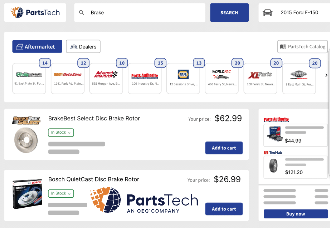
ASN continues to add tools that help make your shop more efficient. We’re excited to announce that PartsTech is now integrated into the ASN Shop Management System, giving service shops a faster and easier way to search for and order parts.
If your shop uses the ASN Shop Management System, you'll notice a PartsTech link icon above Line 10 on your repair order screen. Click the icon and take a few minutes to explore this powerful new feature.
Everything You Need in One Place
Your Shop Management System is the hub of your business—tracking customers, repair history, labor, invoicing, and more. Now, with PartsTech built directly into the system, you no longer need to jump between multiple supplier websites or browser windows to find the right parts.
With a few clicks, you can:
- Search multiple parts suppliers at once.
- Compare pricing and availability.
- View real-time inventory and delivery estimates.
- Add selected parts directly to the active repair order.
The seamless integration eliminates unnecessary steps, saving valuable time while improving estimate accuracy and customer service.
Real-Time Information Means Better Productivity
Knowing which supplier has the part you need—and when it can be delivered—can make the difference between completing a repair today or delaying it until tomorrow.
PartsTech's cloud-based platform provides up-to-date inventory information and delivery estimates, allowing your shop to make informed purchasing decisions quickly. Faster ordering helps keep vehicles moving through the shop and technicians productive.
Take Advantage of This New Tool
If you haven't tried PartsTech yet, now is the perfect time. Simply click the PartsTech icon within your ASN Shop Management System and see how easy it is to search, compare, order, and add parts directly to your repair orders.
This is another example of ASN providing members with tools that improve efficiency, reduce wasted time, and help your shop operate more profitably.
Stay Ahead of Fraud
Posted Thursday, July 30, 2026

Fraud is constantly evolving, and criminals are becoming more sophisticated in the ways they target individuals and businesses. Staying informed and vigilant is one of the best ways to protect yourself and your finances.
This year, we're seeing a significant increase in several types of fraud, including:
- Phone Scams
- Business Email Compromise (BEC)
- Elder Financial Exploitation
- Online Ticket and Merchandise Scams
Beware of Phone Scams
One of the fastest-growing fraud tactics is caller ID spoofing, where scammers manipulate the caller ID to make it appear as though a call or text message is coming from your bank. Their goal is to create a sense of urgency and convince you to share sensitive personal or financial information.
Scammers often claim they have detected suspicious activity on your account and need to verify your identity. While a legitimate representative from your bank may contact you regarding account activity, they will never ask for:
- Your full debit card or account number
- Your online banking username or password
- Your one-time verification or multi-factor authentication (MFA) codes
If you receive a call or text that seems suspicious, hang up immediately and contact your bank using the phone number listed on its official website, the back of your debit card, or your account statement. A legitimate bank representative will always respect your decision to call the bank directly.
How You Can Protect Yourself
Protecting your accounts is a shared responsibility. These simple habits can significantly reduce your risk of becoming a victim of fraud:
- Stay cautious. Never share personal or financial information with someone who contacts you unexpectedly.
- Verify the caller's identity. If a call or text seems suspicious, hang up and contact your bank using a trusted phone number.
- Monitor your accounts regularly. Review your transactions frequently using your bank's mobile app or online banking and report any unauthorized activity immediately.
- Enable dual approval for wire and ACH transactions. Requiring a second approval helps verify transactions, reduces errors, and provides an additional layer of protection against fraud.
- Report concerns immediately. If you suspect fraud or notice unusual account activity, contact your bank as soon as possible.
Don't Let Scammers Ruin the Experience
With major sporting events, concerts, festivals, and other popular events taking place throughout the year, fraudsters are taking advantage of excited fans by creating fake websites and selling counterfeit tickets and merchandise.
Before making a purchase, remember these safety tips:
- Purchase tickets and merchandise only from official websites or authorized sellers.
- Verify the website address (URL) before entering payment information.
- Be cautious of unsolicited offers or prices that seem too good to be true.
- Never send payments using cryptocurrency, gift cards, or wire transfers when purchasing tickets or merchandise.
- Watch for warning signs such as spelling errors, poor website quality, or high-pressure tactics urging you to "buy now."
- Many legitimate websites ask you to verify you're human by selecting images. Be cautious if a website instead asks you to enter keyboard shortcuts, download software, or perform other unusual actions.
ASN Support Alert
Scammers frequently impersonate technology support providers and attempt to gain remote access to your computer.
Remember: ASN only uses ASN Tech Connect to establish a remote connection when you have contacted us and requested technical support. We will never make an unsolicited (cold) call asking to connect to your computer, and we do not use any remote access platform other than our own secure connection method.
If someone claiming to represent ASN contacts you unexpectedly and asks you to install software or grant remote access:
- Do not allow them to connect to your computer.
- Do not use any remote connection method suggested by the caller.
- Hang up immediately.
- Contact ASN directly using our published phone number to verify whether the request is legitimate.
When in doubt, always verify first. Taking a few extra moments to confirm who you're dealing with can help protect your personal information, your finances, and your peace of mind.
California sends Tesla a message with its new EV rebate
Posted Thursday, July 30, 2026

The statement is political, and Elon Musk won’t be happy.
Electric vehicles have had a rough year. Washington killed the $7,500 federal tax credit last September, and price-sensitive buyers scattered almost overnight. New EV sales fell 27% in the first quarter of 2026, sinking to 5.8% of the market, according to Cox Automotive.
California felt it worse than most. The state that built the American EV habit watched its own electric share slide toward levels it hadn’t seen in years, well short of the targets it set for itself.
So the state decided to step back in. Governor Gavin Newsom signed SB 168 on Monday, July 13, creating a program called MyFirstEV that takes $3,500 off an electric car right at the dealership. Read the fine print, though, and you find a rule that lifts Rivian and Lucid, caps Tesla (TSLA), and lands like a message addressed to Austin, Texas.
How the instant EV rebate works
MyFirstEV throws out the old model. California’s previous Clean Vehicle Rebate Project made buyers apply and wait for a check. This one is a point-of-sale discount, so eligible buyers walk into a participating dealership and drive out with the money already gone from the price.
The terms look simple on the surface.
- $3,500 off a new EV priced under $50,000, or $1,750 off a used one under $25,000, according to the Governor’s office.
- A combined pool near $270 million once automakers match the state’s $135.5 million, according to the Governor’s office.
- Rivian’s cheapest model runs about $58,000 and Lucid’s about $71,000, yet both still qualify, according to Electrek.
- New U.S. EV sales dropped 27% in the first quarter of 2026, according to Cox Automotive.
There is no income cap, which is the first thing that jumped out at me. California spent years making its incentives means-tested, steering the biggest help toward lower-income drivers. This program flips that.
Price is the only gate, the buyer has to be a California resident, and they just attest that this is their first zero-emission vehicle. A curb-weight limit of 8,500 pounds keeps it to ordinary passenger cars, and the California Air Resources Board (CARB) is still finalizing deals with automakers, with a launch expected later this summer.
The headquarters loophole that boxes out Tesla
Here is the part that turns a discount into a statement. That $50,000 price cap vanishes for EVs built by California-headquartered, EV-only automakers, judged by where a company’s management sat on January 1, 2026, according to Electrek. In practice, that describes exactly two carmakers.
Rivian (RIVN), with engineering offices in Irvine, makes the cut. So does Lucid (LCID), based in the San Francisco Bay Area. Their entry models sit thousands of dollars above the cap that binds everyone else, and they collect the full $3,500 anyway.
Tesla (TSLA) does not. The company moved its headquarters to Austin, Texas, in 2021, so it no longer counts as a California automaker under the rule. Only its sub-$50,000 Model 3 and Model Y configurations qualify. The Cybertruck, the Model S, and the Model X get nothing.
When I ran the eligible models against the price caps, the tell was obvious. The exemption rewards where a company keeps its logo, not where it builds its cars. Tesla still assembles hundreds of thousands of vehicles a year at its Fremont, California, plant, more EVs in the state than anyone. Rivian builds in Illinois. Lucid builds in Arizona.
The framing is hard to miss given the long public feud between Newsom and Tesla CEO Elon Musk. Newsom’s office cast the whole package as a stand against President Donald Trump’s push to “surrender the clean car industry to China on a silver platter,” according to the Governor’s office.
Electrek was blunter, writing that the carve-out “turns an affordability program into a political statement,” according to Electrek.
What the rebate means for California buyers
Strip away the politics, and the $3,500 is real money. For a family financing a new car, that is a few months of payments erased before they leave the lot, or a serious dent in the down payment on a tight budget.
The used-EV piece may matter even more. A wave of off-lease electric cars is landing on dealer lots, and $1,750 off a sub-$25,000 vehicle is the kind of discount a first-time buyer actually feels.
Plenty of mainstream options clear the $50,000 line. GM (GM) has the Equinox EV, the Blazer EV, and the Bolt, which starts under $30,000. Ford’s (F) Mustang Mach-E, Toyota’s bZ, and Hyundai’s Ioniq 5 all qualify too.
What struck me reading the bill was the quiet math of the no-income-cap rule. A first-time buyer picking up a $71,000 Lucid gets the same $3,500 as a family stretching for a $30,000 Bolt, and arguably a better deal, since that luxury sedan would not qualify for a dime anywhere else. A program sold as help for regular families also happens to underwrite some of the priciest EVs on the road.
Why this EV fight is far from over
The loophole is the kind of thing lawyers notice. Rewarding a corporate flag over actual California manufacturing invites a challenge, and Tesla, the state’s largest EV employer, would have a real argument that the rule punishes it for a headquarters address.
There is a bigger backdrop, too. The post-credit slump amounted to “a necessary reset,” according to Cox Automotive, and U.S. sales ticked back up in the second quarter as state programs stepped in, according to InsideEVs. California is betting it can rebuild that momentum one first-time buyer at a time.
The message to Tesla landed on July 13. The reply may come from a courtroom, and whatever a judge decides could tell every other state how far it can go in picking winners with public money.
Anyone shopping for a first EV this summer should read the sticker closely, because in California, the discount now depends on more than the car.
Source: TheSteet
Used-car market has ‘strength and resilience’ despite forecast of slightly softening sales
Posted Thursday, July 30, 2026
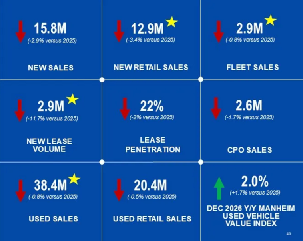
Cox Automotive recently projected slight softening of certified pre-owned vehicle sales and overall used-car retail transactions for the year.
But experts also see the movements reflected “strength and resilience” of the used-car market.
Let’s get into the numbers.
As part of its Q2 2026 Mid-Year Review in Detroit, Cox Automotive chief economist Jeremy Robb recapped that this year’s used-car retail sales are expected to come in at 38.4 million units, which would be down less than 1% year-over-year.
Robb added that Cox Automotive is still expecting to see 2.6 million CPO sales this year. That number would represent roughly a 2% drop compared to last year’s final tally.
The projections prompted Cox Automotive deputy chief economist Mark Strand to say, “When you combine the tough comp versus the tariff driven market frenzy with an energy shock, rising inflation and ongoing general affordability pressures, the small decline in the used sales pace looks like relative strength and resilience.”
As part of its Q2 2026 Mid-Year Review in Detroit, Cox Automotive chief economist Jeremy Robb recapped that this year’s used-car retail sales are expected to come in at 38.4 million units, which would be down less than 1% year-over-year.
Robb added that Cox Automotive is still expecting to see 2.6 million CPO sales this year. That number would represent roughly a 2% drop compared to last year’s final tally.
The projections prompted Cox Automotive deputy chief economist Mark Strand to say, “When you combine the tough comp versus the tariff driven market frenzy with an energy shock, rising inflation and ongoing general affordability pressures, the small decline in the used sales pace looks like relative strength and resilience.”
Source: AutoRemarketing
Car dealer closes 40% of its stores, shares bankruptcy warning
Posted Thursday, July 30, 2026

The company has warned that it may not have enough cash to survive.
I haven’t met many people who were actually able to afford a new car.
Sure, plenty buy them, but suffocating monthly loan payments mean the “affording” part isn’t exactly met.
For decades, we shrugged off the warning that a new car loses 10% of its value the second it leaves the lot. The counter-argument was simple: You paid for peace of mind and the guarantee you wouldn’t end up stranded on the road.
But today, even buying a used car is a crushing mathematical problem.
According to Edmunds, the average monthly new-car payment has hit a record $777, and 20.3% of buyers pay $1,000 or more monthly. To cope, many stretch loans over six or seven years. Edmunds’ Ivan Drury calls this a “mathematical trap,” warning that pairing a 7.0% APR with an 84-month loan means handing over nearly $10,000 in interest alone, leaving buyers “highly vulnerable to falling underwater.”
Used-car buyers are squeezed just as hard, financing an average of $30,414 at 10.5% interest. For subprime buyers, Experian data show interest rates averaging a staggering 19.4% to 21.7%.
That pressure isn’t just hurting buyers. It is also hitting the dealerships that specialize in financing customers with weaker credit. Now, one of the largest chains in the country has dramatically reduced its footprint.
A major automotive retailer that operates a chain of used-car dealerships, America’s Car-Mart reported on July 14, 2026, its fourth-quarter and full-year results for the period ended April 30, 2026.
The car dealer, which specializes in the “buy here, pay here” (integrated auto sales and financing) market, reported total revenue of $1.281 billion, down by 7.9% from fiscal 2025.
America’s Car-Mart full fiscal 2026 earnings vs. fiscal 2025:
- Gross profit per unit improved 1.0% to $7,442.
- Gross margin percentage of 35.4% versus 36.7%.
- Net loss amounted to $139.11 million, versus net income of $17.93 million.
- Net loss per share was $16.79, compared to earnings per share of $2.38.
In the report, America’s Car-Mart confirmed it has consolidated 60 dealership locations in the period of 12 months (from April 30, 2025, to April 30, 2026). The company’s active dealership count decreased from 154 to 94, resulting in a 40% footprint reduction.
Why has America’s Car-Mart been closing so many locations?
America’s Car-Mart began showing the first signs of trouble more than a year ago. After digging through its official reports, I found that in December 2025, the company’s official Q2 FY26 Management Script said it had closed a $300 million term loan that removed the capital-related limits to optimize its store footprint and organization structure.
“Now with more flexibility, we’re moving decisively on a multi-phase plan to optimize our footprint, cost structure, and strengthen capital efficiency,” stated America’s Car-Mart CEO Doug Campbell.
Campbell added that phase one was executed in early November by consolidating five underperforming stores and eliminating approximately 10% of its employees. The second phase was set for Q3 and was projected to result in more than $20 million in annualized SG&A savings.
On Jan. 13, America’s Car-Mart confirmed in a press release it has completed phase 2 by consolidating 13 of its locations into higher-performing nearby dealerships. Combined with phase 1, that makes 18 consolidated locations in those two phases.
As of the July 14 earnings release, the company has not yet disclosed the locations of the remaining 42 dealership locations that were consolidated in the fourth quarter of fiscal 2026.
“Faced with limited origination capital and no revolving warehouse facility, we intentionally reduced originations and inventory to protect liquidity and avoided originating loans we lack the capacity to carry,” Campbell said during the Q4 and full fiscal 2026 year earnings call.
America’s Car-Mart issues “going concern” disclosure
While retailers frequently close underperforming stores to improve profitability, the situation of America’s Car-Mart appears to go beyond routine cost-cutting.
As part of my recent retail tracking coverage for TheStreet, I’ve documented how several major mall staples are executing similar strategies to protect their profit margins. Fossil Group shuttered seven stores during the first quarter of 2026 alone, and Vera Bradley closed 13 underperforming retail locations.
Another example is fashion mall retailer Tilly’s, which successfully cut its rent and operating costs by closing 40 underperforming locations and opening 12 new ones over two years.
This optimization boosted quarterly gross profits to $36.1 million and dramatically shrank the company’s net losses. It recently confirmed plans to open three new stores later this year.
However, mall fashion retailers are a completely different type of business than a “buy here, pay here” car dealership, and the management views liquidity, not merely store efficiency, as the primary challenge.
In fact, Campbell confirmed in a call that there will be “going concern disclosure in our Form 10-K. It’s there because we have not secured additional financing or an alternative transaction that we need to resolve our liquidity constraint, not because anything changed in how our customers are paying us back.”
What is a “going concern”?
The going concern principle assumes that an organization or business is financially stable enough to continue to operate for the foreseeable future, typically the next 12 months.
A going concern disclosure does not mean a company will file for bankruptcy. It indicates that management has identified conditions that raise substantial doubt about the company’s ability to continue operating over the next year.
Source: TheStreet
What's New -July 2026
Posted Tuesday, June 30, 2026
Used-Car Market Shows Strength Despite Softer Outlook
Posted Tuesday, June 30, 2026
Focus on the Opening
Posted Tuesday, June 30, 2026
Car dealership warned about ‘deceptive pricing’ by the FTC
Posted Tuesday, June 30, 2026

VISALIA, Calif. A Visalia auto dealership was among almost 100 auto dealership groups nationwide warned by federal officials about advertising prices that customers could not actually receive.
The Federal Trade Commission (FTC) announced in March that it was sending letters to 97 auto dealership groups nationwide warning them that the prices they display must be the total price, including all mandatory fees.
Among the groups was Visalia Hyundai, located at 220 S. Ben Maddox Way in Visalia. A representative from Visalia Hyundai says they bought the dealership in January, and it’s now under new ownership.
The letter sent by the FTC to Visalia Hyundai alleges that the dealership was “advertising prices for cars that are lower than what you actually charge consumers.”
The FTC cites some of these “illegal pricing practices” as:
- Advertising a price that does not reflect all required fees
- Advertising a price that reflects rebates or discounts not available to all consumers
- Advertising a price that fails to take into account the amount of an additional required down payment
- Conditioning the advertised price on consumers using dealer financing
- Requiring consumers to buy additional items not reflected in the advertised price
- Advertising unavailable or nonexistent vehicles
The FTC stated they reached out to Visalia Hyundai because they were “concerned” the dealership “may be engaging in one or more of these practices.”
The representative of the dealership said that the new ownership had nothing to do with the deceptive pricing allegations.
“This letter is not intended to be a comprehensive statement of concerns that may exist about your dealership or dealership group. Nor is it intended to represent any conclusions on whether your dealership or dealership group is engaging in these practices,” the letter read in part.
The FTC stated that the warnings issued are part of a wider effort to examine all markets, including rental housing, grocery delivery services, and hotels.
Source: CBS47